Back when Glasnost was a thing
There was a period of time before the whole East - West thing froze solid again, and after that original coldness had started to thaw out, that it seemed like Western Europe / USA and Russia / USSR would be friends.
It was Mikhail Gorbachev who really wanted to be our friend and started the unthawing, or perhaps more accurately he wanted his country to be less poor and stuck in the 1950s.
So, what you ask, has this got to do with music?
Well, for much of the so-called Cold War, western pop and rock music was viewed with, at the very least, extreme suspicion by successive Soviet leaderships. The bourgeois values such acts represented was galling for any hardline communist worth their salt, and in some cases, perceived as an actual threat to national stability.
Yes, by the 1980s there were official lists of bands that had ideological charges made against them; AC/DC were apparently neo-fascists, Iron Maiden offered religious obscurantism (whatever that is), Madonna and Prince were both too erotic, and anything punk was, well, too punky…
Yet despite that, a few select acts were allowed in to play the odd show here and there - but always at the invite of the State, and very much controlled. Cliff Richard, believe it or not, was the trend setter, pitching up for a gig as far back as 1976 (and incredibly they invited him even after Devil Woman had been released)! Over the next decade there would be shows officially put on by everyone from Elton John and Billy Joel, to unbelievably, Iron Maiden and Ozzy Osbourne.
Over The Wall
Our story is not quite in Russia yet, but bear with us.
In June 1988, with the Berlin Wall still looming as the rather large embodiment of east-west division, a Peace Concert was held in East Berlin. It was almost certainly the strangest open air music festival in Europe that year, with large crowds (estimated 150,000) notable for their unfashionable clothing and preponderance of mullets turning up to greet a selection of ‘western’ bands many probably thought they would never get to see in the flesh.
While they perhaps didn’t know many of the songs being played to them, the fact that this handful of western rock stars had turned up to play for them was enough on its own. Prog rockers Marillion had headlined one night, while the second day saw the twin rock attack of Bryan Adams and Big Country.
Big Country: Look Away (live in Berlin, 1988)
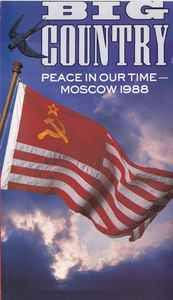
Peace In Our Time
Having made a name for themselves with three fairly Scottish themed albums, Big Country perhaps surprised more than a few people with album number four. Not only in its musical direction, taking a slightly more refined, direct and, some might say, American approach (produced by Peter Wolf of J. Geils Band fame) - the way it was launched probably caught a few off guard too.

On 21 September 1988, with the Cold War still very much on, despite the movement of Gorbachev towards glasnost and perestroika, Big Country appeared at the Soviet Embassy in London to launch Peace In Our Time - their fourth record.
Grasping the concept of glasnost very firmly, they were intent on promoting and encouraging east-west cultural relationships, doing their bit to hasten the thawing of the political war. But it wasn’t just about staging a press conference on a scrap of Soviet land in Notting Hill Gate, West London, oh no… It was also to announce that a week or so later, they would be playing the first gigs of their next tour… in Moscow!
They played a half hour set, got some great international press and were also presented with their visas for the upcoming trip. Of course, the press already knew what was afoot, because they were in the loop to ensure they also travelled to Russia to cover the shows.
Big Country at the Soviet Embassy (brief news clip from the embassy launch)
This seemingly crazy idea was, according to co-manager Alan Edwards, the idea of his fellow manager Ian Grant; “Around that time the Reagan / Gorbachev summit was happening in Iceland. There was a lot of meetings and discussions on it. And the sort of idea entered people’s heads, but particularly Ian Grant's, ‘What a great idea, we could do something to bring together different nationalities and bring together the east and the west.” High falutin’, preposterous and over-confident, or just plain crazy - only time would tell.
Luckily for the band, their label (Phonogram) were also fully on board and supportive. Senior marketing man at the label, Nick Rowe, said “[the] music industry has broken many barriers and taken the lead where others feared to go - we fed the world [with Band Aid and Live Aid]. The record industry should also be a big part of exchanging culture and ideas with the Soviets.”
Many Firsts
As noted, quite a few bands had, by now, played the odd gig in Russia - and Big Country were almost the first to play multiple shows, but those veteran rockers, Status Quo, beat them by a month, when they did a run of 14 shows in late August.
But no one had ever come over without first being invited by the Kremlin. Ian Grant was determined to break down that barrier and negotiations begun; the first attempt to be invited - refused.

Undeterred, Grant soldiered on. More discussions, reaching out to anyone that might be able to help - officials, peace committees and other music management companies. Then, a possible breakthrough. A recent law change was made allowing private individuals to book their own gigs, not using the usual official channels. A name was floated… Stas Namin, something of a Russian rock star (lead singer with Tsvety and Gorky Park) and now preparing to become one of the great impresarios.
He has some local pedigree and his name was known outside the USSR, thanks to perestroika, meaning he had gotten the chance to work with Peter Gabriel and Yoko Ono, and also befriending Frank Zappa. He was also, more importantly, very willing to help with Grant’s crazy notion, and started the wheels of organisation.
The result was monumental. Not just a multi-night set of shows for a western band in Moscow, but ones organised completely outside of the Kremlin’s control - for the first time ever! Yet even with his reputation and a new law to back him up, it still took some doing. It certainly didn’t hurt that he had a grandfather who happened to be a government official with some clout (he was actually in the politburo).
Big Country: Peace In Our Time (live in Moscow, 1988)
There was another, perhaps slightly more minor, first - the shows would have standing tickets available, something unprecedented for a Soviet music performance. The chance for a fuller Russian tour (St Petersburg etc) also seems to have been discussed and then discounted owing to logistical and financial challenges. So in the end, the tour was a five night run of shows in Moscow.
Grey Russia?
Bassist, Tony Butler recalled what it felt like to head to Moscow for the first time. “You just have to go there with completely open eyes and a clear mind and just sort of take it in… [by the end of the trip] I think everybody got used to the environment and ended up really appreciating it; but you have to realise that it’s so different out there.”
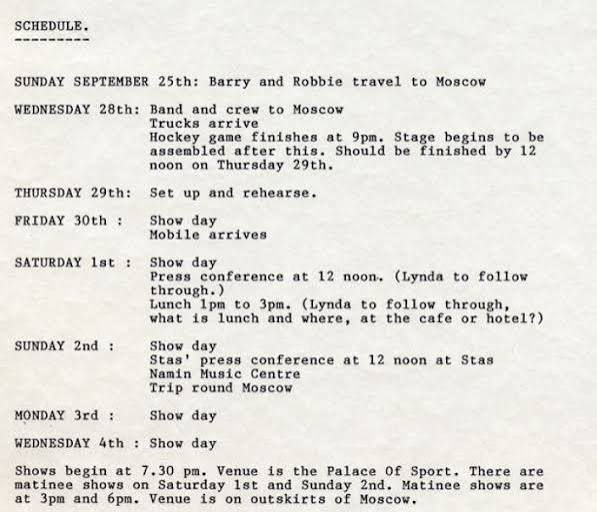
Drama kept unfolding, even after the band had arrived in the USSR (on 28 September). Firstly, the venue for the gigs was switched from the Lenin Sports Stadium to the Moscow Palace of Sports, to allow for more standing room. The team were also scrabbling around to find enough cameras so that the planned filming of the shows could happen. Then, the venue was switched again, this time to the Soviet Wings Sports Palace, an old ice rink which apparently could hold 8,000 for a music show.
The decision to use Namin for not only the show organisation, but also for the practical and logistical setting up of the concerts, seems to have put Goskontsert’s nose out of joint (the official state appointed organisation for such things) and they did their best to throw in some extra challenges to getting the shows on.
One such challenge was the effort it took the crew in getting the stage set up and ready, with the crew bemoaning that getting anything done took hours and there were various issues with the equipment. Luckily, the issue with Goskontsert was resolved and things became smoother.
Big Country: Chance (live in Moscow, 1988)
Not that there weren’t still disruptions, even during the actual shows, as equipment struggled with the phasing and voltage. But the shows went ahead, with Namin ensuring there was plenty of local musical interest on the bills, giving the concerts a bit of a festival feel, with the big irony being that because of the previous cultural restrictions in place, no one in the Soviet Union really knew who Big Country were.
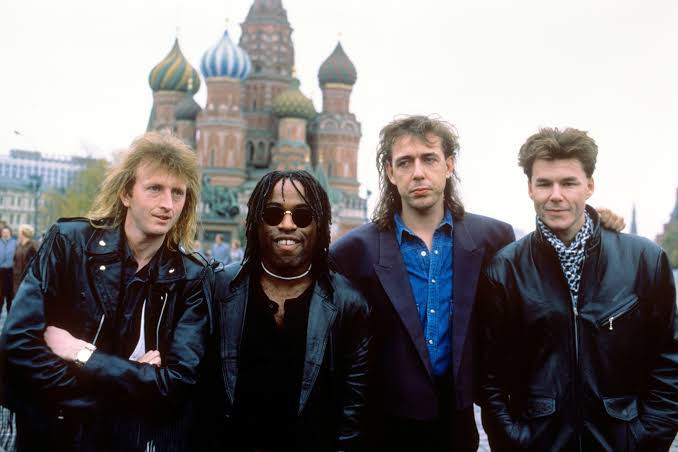
It was a massive culture shock for the band, with guitarist Bruce Watson later remembering that “It was a completely different world”, with no one really knowing their music beyond maybe a handful of the hits being heard by some on underground radio. In fact, the awareness levels of locals of Big Country led to jokey remarks that with such huge numbers of British journalists travelling to Moscow, they almost outnumbered the locals on the first night. However, a well timed appearance on a popular TV game show (salted fish was apparently the big prize on offer), lip synching to one of their tracks, ensured that more genuine local music fans were in attendance by night two.
The final show was on 4 October and then it was time to return home. The band and record company had invested as much as £500,000 into this adventure; for crew, equipment and accommodation - and the last thing that perhaps many weren't expecting, was that legally, any money they might have made back from the shows, had to stay in Russia, and that they also had to ‘donate’ (i.e. leave behind) their new equipment for the benefit of current and future local musicians - so at least it went to a good cause.
Despite everything, Watson thought the challenges were ultimately worth it; “It was expensive, difficult and completely different from what we were used to, but I wouldn’t change it.” It was a shame, he thought, that they only got to Moscow - “We were stuck in Red Square for 10 days! I’d love to go and see all these other places - you can’t just say I’ve been to Russia when you’ve only been to Moscow.”
Big Country: King Of Emotion (live in Moscow, 1988)
Genuine Glasnost or PR Stunt?
Was all this talk about building cultural bridges and forging east-west relationships for real, or was it just a massive PR stunt to generate album sales?
You could quite easily argue that it was both of these.
However, it seems clear that the desire to go to the USSR and make a difference was genuinely felt, they had always been perceived as a genuine and earnest band; but the opportunity to generate some positive press, attention and maybe some additional record sales wasn’t a bad by-product.
Some, like BBC Radio’s Jonathan Ruffle, seemed to think it was both, but also maybe even more than that - “There are probably two reasons they are going to Moscow, The first is probably a reason of conscience, and second, it is a marvellous hype,” going on to point out that, “It would definitely develop a great deal of interest in the industry.”
Namin was very clear though, this tour was not about money (“We are not going to make any money on it, We just try to arrange good times and comfort for the musicians, for the audience and for the media people.”) - it was all about signalling a change, generating interest in rock music in the country, and bringing what scene there was, out from the underground. “I think we have very talented musicians now”... with the changing laws, “they don’t cut our lyrics any longer, we can record what we want.”

Stuart Adamson seemed clear about the positives, and limitations, of the concerts, when he told Scottish based student journalists Kane Rutherford and David Miller after the first show (30 September); “People will learn more about each other through music and they will break down barriers. I hope we have achieved something towards that. Even if nothing comes out of the concerts, it’s still enough to look into those kids’ eyes and know that we have made contact.”
Big Country: In A Big Country (live in Moscow, 1988 - enjoy the moment, around two minutes in, when Adamson steps down from the stage, ignores those stern security men and engages with the crowd)
The fact that the concert security personnel, while looking stony faced as usual, were allowing (grudgingly or not) fans to be on their feet, dancing and singing, was something very new. This was not lost on drummer Mark Brzezicki; “Normally… I get lost in the music, I tend to get in a trance… But this time, I was actually looking out and going, wow! I’m actually in Moscow, and they’re standing up! And they’re actually getting into it! They were trying to sing the words and things… I had shivers down the spine.”
The technical challenges and the unfamiliar crowds meant that the shows were never going to be among their best live performances; Watson remarked in an interview at the time, out in Red Square, “The gigs have been a bit strange - playing at the old ice rink.” But they did achieve so much more than that culturally speaking. Young Russians got to sing and dance in public to western music, truly ensuring that peace in our time had been delivered (at least for a while).
If this story has been of interest in any way - there is a an hour-long documentary made at that time, produced by Storm Thorgerson (art director best known for working with Pink Floyd): River Of Hope


Comments